Monday, May 21, 2018

Border Spy Cam

LEGiTiGO


Man removes feds’ spy cam, they demand it back, he refuses and sues

74-year-old rancher and attorney was walking around his ranch just south of Encinal, Texas, when he happened upon a small portable camera strapped approximately eight feet high onto a mesquite tree near his son's home. The camera was encased in green plastic and had a transmitting antenna.

Not knowing what it was or how it got there, Ricardo Palacios removed it.

Soon after, Palacios received phone calls from Customs and Border Protection officials and the Texas Rangers. Each agency claimed the camera as its own and demanded that it be returned. Palacios refused, and they threatened him with arrest.

Palacios, who had run-ins with local CBP agents going back several years, took the camera as the last straw. He was tired of agents routinely trespassing on his land, and, even after complaining several times, he was frustrated that his grievances were not being heard.

As a possible way to ward off the threat of arrest, he sued the two agencies, along with a named CPB agent, Mario Martinez. Palacios accused them of trespass and of violating his constitutional rights.

"My client is 74 years old, he's a lawyer, been practicing for almost 50 years, he has no criminal history whatsoever, law-abiding citizen, respected lawyer and senior citizen," Raul Casso, one of the attorneys representing Palacios, told Ars. "To have put him in jail would have been—forget the indecency of it—what a way to end a career."

This federal lawsuit has raised thorny questions about the limits of the government's power to conduct surveillance—in the name of border security—on private property, without the landowner's permission.

Monday, May 14, 2018

Seasonal Workers Visa

LEGiTiGO


Delays in the Increase of Seasonal Worker Visas May Prove Too Late for Certain Industries

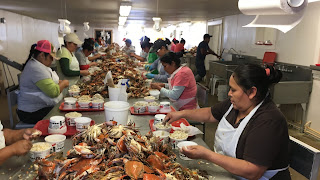
Failure to get H-2B (seasonal worker) visas approved has put Maryland’s seafood industry in jeopardy. Almost half of the Eastern Shore’s crab houses do not have workers they need to pick the meat as the crab season begins. The government’s inability to meet employers’ growing seasonal labor demands will not only have a detrimental impact on Maryland’s economy, but on other states with industries that heavily rely on seasonal workers.

To meet labor shortages, many employers depend on the H-2B visa program, which brings at least 66,000 foreign workers to the country every year to work in non-agricultural seasonal jobs.
Arduous working conditions in many of these industries—such as the crabbing, fishing, landscaping and forestry sectors—have contributed to significant labor shortages.

This year proved to be particularly challenging for many industries that employ seasonal workers. The U.S. Department of Labor (DOL) received an “unprecedented level of employer requests,” for positions which led to delays in processing and issuing certifications. Thus, it was the first time that immigration officials granted these visas by a lottery due to the high demand.

Employers seeking H-2B workers need a temporary labor certification from DOL issued only after they meet certain regulatory requirements, including recruiting for U.S. workers, and USCIS approval of an H-2B visa petition.

The negative effects of these changes were felt particularly by Maryland’s crab businesses. Of the 500 foreign workers that are needed each season through the H-2B visa program, applications for around 200 of those visas were denied in February of this year.

Monday, May 7, 2018

Risk of Deportation

LEGiTiGO


After Almost 20 Years,
Honduran Temporary Protected Status Holders Lose Permission to Stay

Nearly 60,000 Hondurans learned that they will no longer be able to remain in the United States with Temporary Protected Status (TPS), placing them at risk of deportation when termination takes effect in 18 months. Having lawfully resided in the United States for many years, Honduran TPS holders now face the impossible choice of whether to leave the homes and families they’ve created in the United States only to face an unfamiliar country plagued by pervasive violence.

The Presidential administration has been on a steady crusade against TPS, Honduras being the seventh decision to terminate a country’s designation for TPS (or a related form of relief called Deferred Enforced Departure) in just the past eight months.  Honduras is the last of the large TPS designations to be cut, with El Salvador (195,000 beneficiaries), Haiti (46,000 beneficiaries) and Nepal (8,950 beneficiaries) all being ended since November.

Honduras was originally designated for TPS in 1999 following the devastation wrought by Hurricane Mitch, the second deadliest Atlantic hurricane on record that left millions homeless. Since that time, the Department of Homeland Security (DHS) and the State Department have regularly reviewed country conditions, finding that Honduras continued to meet the conditions for a TPS designation as required by law.
In past decisions to extend TPS, the Secretary of Homeland Security appropriately looked at a range of relevant issues that complicated the Government of Honduras’ ability to recover from the disaster and absorb the return of tens of thousands of its nationals, including: the availability of ample housing; the existence of critical infrastructure; the reliability of power sources; the availability of sufficient food and clean water; the stability of the Honduran economy; and how new environmental disasters have complicated recovery.

Monday, April 30, 2018

Recommendations

LEGiTiGO


Department of Justice Ignores Its Own Evaluators’ Recommendations on Immigration Courts

A newly-released document obtained under the Freedom of Information Act (FOIA) shows that the Department of Justice (DOJ) is making radical changes to the immigration court system that deliberately contradict the recommendations given to the department by its own independent evaluators.

The recommendations were made in an April 2017 Booz Allen Hamilton report commissioned by The Executive Office for Immigration Review (EOIR)—the agency that houses the immigration courts. The year-long analysis summarized in the report recommended steps to resolve inefficiencies in the immigration court system that have contributed to the courts’ ballooning caseload. In several instances, the report recommended solutions that made the system more efficient and effective without compromising fairness, such as placing the merits of the immigration case decisions over case completion quotas.

The report—initially obtained after the American Immigration Council and the American Immigration Lawyers Association submitted a FOIA request for the report and related documents—was released in the wake of a highly controversial decision by EOIR to apply case completion quotas to immigration judges.

These new quotas require immigration judges to complete 700 cases per year, avoid having their decisions reversed by the Board of Immigration Appeals and courts of appeals (judges must maintain a reversal rate of less than 15 percent), and meet a variety of additional benchmarks, such as short deadlines for issuing removal decisions or bond decisions.

Monday, April 23, 2018

CBP Abuses

LEGiTiGO


High Profile Cases Highlight Border Patrol Abuses and Need for Systemic Change

U.S. Customs and Border Protection (CBP)—the Border Patrol in particular—has a reputation for repeatedly and systematically violating the rights of immigrants and U.S. citizens alike. Border Patrol agents are known for regularly using excessive force during apprehensions, detaining people under inhumane conditions, and resorting to coercion and misinformation in order to remove people from the United States. Despite the growing number of reports and studies which document these misdeeds and recommend systemic reforms to prevent them, a pattern of abusiveness remains.

For instance, in April 2018, a video from March 2017 surfaced which captured an incident in which two Border Patrol agents operating along the border in El Centro, California, tried to dump an injured and incoherent man on the Mexican side without even verifying from what country he actually came. When Mexican border guards asked the agents how they knew the man was in fact Mexican, one of them replied, “He looks like it.” The Mexican guards also reminded the Border Patrol agents that bilateral agreements between the United States and Mexico specify that any deportee from the United States must be processed through the Mexican consulate on the U.S. side of the border. The agents responded by claiming that the man was not actually in their custody—even though they had him handcuffed.

At times, the conduct of Border Patrol agents seems gratuitously cruel. A prime example from October of 2017 occurred when Border Patrol agents detained a 10-year-old girl with cerebral palsy after she’d undergone emergency gallbladder surgery in Corpus Christi, Texas. The car in which she was riding passed through a CBP checkpoint, at which point she proceeded to the hospital in an ambulance. CBP agents “escorted” the ambulance to the hospital, where they waited outside of the girl’s room until they could detain her and put her in deportation proceedings.

Likewise, in March of 2018, a Mexican woman in San Diego was arrested by Border Patrol agents in front of her three children as they stood at the side of the road and cried. CBP insisted that the woman was part of a human-smuggling network; specifically, that she recruited drivers to take undocumented immigrants to a “stash house.” However, she apparently had no criminal record and was not being criminally prosecuted. Rather, CBP was processing her administratively for the civil violation of being in the country without authorization.

Monday, April 16, 2018

Immigrants in the NBA

Immigration Made Easy


2018 Playoffs to feature record 62 immigrant players from 33 countries

NEW YORK, April 12, 2018 – The National Basketball Association (NBA) announced today that team rosters (active and inactive) for the 2018 NBA Playoffs will feature a record 62 immigrant players from a record 33 countries.

All 16 teams competing in the playoffs will feature at least one immigrant player.  The Utah Jazz and Philadelphia 76ers have an NBA-high seven immigrant players each.  The Boston Celtics, Toronto Raptors and San Antonio Spurs each have six.  The Spurs’ 2014 NBA Championship team featured a record nine immigrant players during the playoffs.

The most represented countries among the 62 immigrant players on playoff rosters are France and Australia (seven players each), followed by Canada (four players), Spain (four players), Turkey, Croatia, Cameroon and Brazil (three players each).  Thirty-six of the record 64 European players who were on opening-night rosters for the 2017-18 season are on playoff rosters.

Four-time NBA Champion Tony Parker (San Antonio Spurs; France) will be making his 17th straight playoff appearance, the longest active streak among all NBA players.

There were 108 immigrant players from a record 42 countries and territories on opening-night rosters for the 2017-18 season.  This marked the fourth consecutive season that opening-night rosters featured at least 100 immigrant players and that all 30 teams had at least one immigrant player.

The previous record for immigrant players in the playoffs (60) was set in 2007, and the previous record for countries and territories represented in the playoffs (30) was set in 2014.

The 2018 NBA Playoffs tip off Saturday, April 14 on ABC.  In the opening game, the defending NBA Champion Golden State Warriors will host the San Antonio Spurs at 3:00 p.m. ET.

Monday, April 9, 2018

Troops to the Border

LEGiTiGO


Trumps Calls in the Troops to the Border—But No One Knows What For

President Trump first announced via tweet—and later a signed proclamation—that he plans to send the National Guard to the nation’s southern border. And yet, at the same time, he acknowledged that border apprehensions (which are used to gauge how many people are attempting to cross the border) are at a 46-year low.

Some have questioned the need for the National Guard at this time given that border apprehensions are so low and the Department of Homeland Security declared just last year that the southern border is more secure and harder to cross than it ever has been before.

There are many other unanswered questions as to what the Trump administration plans to do with National Guard troops on the border. When questioned by members of the media, the Department of Defense and DHS had next to no specifics on how this deployment would happen.

For instance, DHS Secretary Kirsten Nielsen could not say how many National Guardsmen would be sent to the border, their exact location along the border, how long they would remain there, or how much it would cost.

For instance, DHS Secretary Kirsten Nielsen could not say how many National Guardsmen would be sent to the border, their exact location along the border, how long they would remain there, or how much it would cost.

To be clear, this is not the first time that the National Guard has been called to the southern border. President Barack Obama summoned 1,200 National Guard troops in 2010 to aid the Border Patrol with surveillance. Likewise, President George W. Bush called upon 6,000 troops to fill various support roles for Border Patrol agents, thereby freeing more of them to carry out apprehensions.

When President Bush sent the National Guard to the border, there were 70 percent more apprehensions than there are now and 7,000 fewer Border Patrol agents. After President Obama called for the National Guard, the Washington Post reported: “The 1,200 National Guard troops have helped Border Patrol agents apprehend 25,514 illegal immigrants at a cost of $160 million—or $6,271 for each person caught​.”