Monday, December 19, 2016

Sanctuary Cities

CLICK HERE
Click image to submit question
 
 
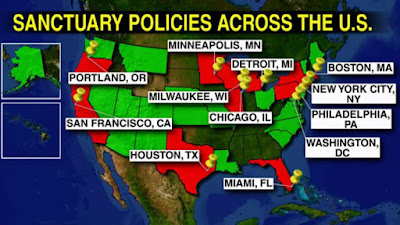
A Sanctuary City is a city in the United States or Canada that has adopted a policy of protecting undocumented immigrants by not prosecuting them solely for violating federal immigration laws in the country in which they are now living illegally. ... The designation has no precise legal meaning.

When did sanctuary cities begin?
 
United States. Local governments in certain cities in the United States began designating themselves as sanctuary cities during the 1980s. The policy was first initiated in 1979 in Los Angeles, to prevent police from inquiring about the immigration status of arrestees.

What states have sanctuary cities?
 
•States. California, Connecticut, New Mexico, Colorado.
•Cities and Counties.
•Arizona. South Tucson.
•California (in addition to all counties) Alameda County. Berkley. ...
•Colorado (in addition to all counties) Arapahoe County. ...
•Connecticut (in addition to state LEAs) Bridgeport. ...
•Florida. Broward County. ...
•Georgia. Clayton County.

How many sanctuary cities are there in the United States?
 
Incredibly, there are over 200 sanctuary cities in the United States that ignore federal law when it comes to prosecuting illegal immigrants.

What are sanctuary cities in USA?
 
Sanctuary city is a name given to a city in the United States that follows certain procedures that shelters illegal immigrants. These procedures can be by law (de jure) or they can be by action (de facto).
 
If you have any questions regarding sanctuary cities or any other immigration topic,
Please contact LEGiTiGO, today


Monday, December 12, 2016

TPS

Click to Submit
Click image to submit question


As a TPS Beneficiary, How Long Is my Work Permit Good For?

Understanding the circumstances under which TPS status may be extended without the person immediately needing or receiving a new work permit.

As a Temporary Protected Status (TPS) beneficiary, you have the opportunity to receive an employment authorization document, often referred to as a work permit or EAD. The work permit has a set expiration date that is tied to your TPS status.

The expiration date on the EAD card itself can, however, be misleading. In certain circumstances, your TPS status may be extended without you immediately receiving (or needing) a new work permit. This article will explain why, and guide you in understanding how this will impact your ongoing TPS status and right to work.

The Work Permit Is Tied to Your TPS Status

When certain emergencies arise in another country, such as a war, earthquake, or civil disturbance, the U.S. Department of Homeland Security (DHS) can designate that country’s citizens, if they are already present in the United States, as eligible for TPS. TPS is a temporary designation that allows its beneficiaries to live and work in the U.S. for the duration of the emergency without fear of being placed into removal proceedings for overstaying a visa. With each designation, however, the U.S. government sets an expiration date, based on how much time it thinks will pass before conditions in the country have improved enough to allow its citizens a safe return.
For more basic information visit LEGiTiGO

Depending on whether or not conditions in your native country have improved since the original TPS designation, the U.S. Secretary of Homeland Security can, as the expiration date approaches, either remove the TPS designation or extend it.

If conditions remain unsafe in the country, then as a beneficiary of TPS, you may receive an extension of six, 12, or 18 months. Most of the current TPS-designated countries have been extended numerous times.

TPS Status and Your Work Permit May Be Automatically Extended

Notice of an extension of TPS designation for your country is provided in the Federal Register, which is basically a daily newspaper of the U.S. government. When the Register announces an extension of your TPS-designated country, it will also explain all the details required to renew TPS, and how it will impact your right to continue working.

You can expect such an announcement within the few months before your EAD expires. To access the register, go to www.federalregister.gov and enter the search terms “TPS” and the name of your country. You can also check the Temporary Protected Status page of the United States Citizenship and Immigration Services (USCIS) website for any updated deadlines and dates of a possible re-extension.

It is important to keep track of when your TPS status expires, and to check the Register and the USCIS website to make sure you will have an opportunity to renew it and find out when the renewal period will open. Often, the renewal window for TPS is short, and will require you to act quickly to ensure that you can maintain your TPS status and continue legally working.

If TPS Is Automatically Extended, Work Permit Continues to Be Valid

If you have any questions regarding TPS or any other immigration topic,
Please contact LEGiTiGO, today

Monday, December 5, 2016

Provisional Waivers

Click to Submit
                                                Click image to submit question


Question:

I am excited about the provisional waiver process, because I have been waiting for years to apply for a green card through my U.S. citizen husband. I am pregnant, however, and worried that my visa interview will be scheduled when I’m due to deliver or caring for a newborn. Is there any way to hurry the interview up? I am willing to pay extra.


Answer:

There's no premium processing option, but you may be able to request an expedited decision.

Everyone applying to U.S. Citizenship and Immigration Services (USCIS) for a provisional or stateside waiver on Form I-601A is naturally eager for a quick decision so that the National Visa Center can schedule the visa interview at the consulate abroad. Although USCIS (as of February 2015) has never released its standard processing times for this application, the goal of the USCIS National Benefits Center is to make a decision within 90 days.

Unfortunately, there is no guarantee that you will receive a decision on your waiver application within 90 days, and it is not uncommon for USCIS to take longer than that to make its decision. Moreover, there is no guaranteed way to bring about quicker action by USCIS. Unlike with some immigration applications, no arrangement exists by which you can pay a “premium processing” fee to guarantee speedy handling of your I-601A stateside waiver application.

Your only hope is to make a request to have your waiver request “expedited.” Such requests are not granted very often. They require a very good reason for making the request, such as a medical, humanitarian, or similar emergency, or the possibility of severe financial loss to a business or a person. Pregnancy, particularly if it involves possible complications, is among the issues which U.S. immigration authorities have considered in other expedite cases – but again, nothing is guaranteed. This is a “discretionary” decision, meaning USCIS is free to make its own judgment about who deserves what.

To ask for an expedite, you can either submit a cover letter with your waiver application requesting the expedite, or send it later, via the USCIS National Customer Service Center (NCSC) at 1-800-375-5283.

With your expedite request, you will need to provide documentary proof of any facts that you are claiming. In your situation, for instance, you would need to provide a letter or records from your doctor verifying the pregnancy and detailing any expected complications that could make it difficult for you to travel later. Be aware that if the wait is already long enough, USCIS may figure that your child will be plenty old enough to travel by the time you are scheduled for a visa interview.
And in the meantime, the fact that you are in the U.S. and presumably with your U.S. spouse makes your case less likely to gain approval than that of someone who is separated from close family.

If you have any questions regarding Provisional Waivers or any other immigration topic,
Please contact LEGiTiGO, today

Monday, November 28, 2016

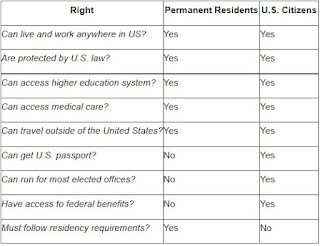
Permanent Resident vs. Citizen

Click Here
Click image to submit question


Permanent Resident vs. Citizen: What's the Difference?

Lawful Permanent Resident:

A lawful permanent resident is someone who has been granted the right to live in the United States indefinitely. Permanent residents are given what’s known as a “green card,” which is a photo ID card
that proves their status. (But it is no longer a green.)

Permanent residence includes the right to work here and to petition for close family members (your spouse and unmarried children) to receive permanent residence and join you. However, your family
members will be considered “preference relatives,” meaning that only a limited number of immigrant visas are available to people in this category per year, and so they are likely to spend five or more years on a waiting list before being allowed to enter or remain in the United States or get a green card.

Permanent residents continue to remain the citizen of another country. So every time you travel outside the United States, you must carry the passport of that country as well as your green card. 
You will use your green card to reenter the United States. There are important limitations on lawful permanent residents’ rights, however. You do not have any rights to vote in U.S. elections. If you leave the United States with the intention of making your home elsewhere, you will be considered to have abandoned your residence and given up your green card.


U.S. Citizen:

People can become U.S. citizens by birth in the United States, through U.S. citizen parents
(depending on the laws in effect at the time of their birth), or through the process known as naturalization.

A U.S. citizen is eligible to receive a U.S. passport, which is issued by the U.S. State department.
Many countries allow visa-free travel for U.S. citizens.

A U.S. citizen can leave and reenter the U.S. at any time without being subject to the grounds
of inadmissibility or requiring a reentry permit. There are no restrictions on the number of days
you can remain outside the United States.

U.S. citizens can vote in U.S. federal and local elections, hold certain government jobs, and serve on juries. Many federal and state government grants, scholarships and benefits are available only to U.S. citizens.

Monday, November 21, 2016

Employer Sponsor

CLICK HERE
Click image to submit question


Can an employer sponsor their employee for immigration and do I need an attorney for this?
 
Submitted by Carlos Borja on Sat, 11/12/2016 - 05:40.
 
Answer:

Yes, a U.S. employer can sponsor an employee for immigration -- either for a temporary work visa (such as an H-1B) or for permanent residence (a green card). The employer would initiate the process, and the employee would submit various applications and likely attend an interview at a U.S. consulate or U.S. immigration office in order to complete it.
 
The process is not likely to be quick or easy, however. It may involve long waits, in categories where limited numbers of visas or green cards are available each year. And you will have to pay the same amount as you would have paid an American worker.
 
U.S. immigration law is notoriously complex. Most of the employment-based categories are for professional-level or skilled workers. Depending on what category of visa or green card your prospective workers applies for, both you and the worker are likely to have to submit extensive proof of things like the job requirements, the applicant's qualifications, and so on.
What's more, if you wish to sponsor the person for a green card, you will in most cases have to conduct a complete recruitment and hiring process first, to make sure that no U.S. workers are capable of and willing to take the job.
 
For more information on eligibility and application procedures for green cards based on work, see "Employment-Based Green Cards."
 
Petitioning for a foreign-born person to receive a nonimmigrant (temporary) visa takes less time and doesn't require the same recruitment efforts, but comes with complications of its own. For example, in the H-1B category, so many people apply that the available visas run out early in the fiscal year.
Submit question "Temporary (Nonimmigrant) Work Visas" at LEGiTiGO for more information.
 
Hiring an immigration attorney to analyze whether you have job openings that might qualify a foreign-born person for a visa and help with the process will save you a great amount of time, and prevent wasted efforts.


Monday, November 14, 2016

Generations

CLICK HERE
Click image to submit question
 

Question:

I am a naturalized U.S. citizen, and my daughter, who is 17, still lives in
our native country. She has a one-year child out of wedlock. If I sponsor
my daughter for a U.S. green card, can she bring her daughter in as well?

Answer:

Unfortunately, the answer is “no” (but read to the end of this article for
alternative strategies
). This is because of a technical (and often illogical)
aspect of immigration law, to do with which immigrating relatives can bring
their own “derivatives” (spouse and minor children) to the United States with
them on the same application.

In cases of immediate relative relationships (which include the spouse, parents,
and unmarried, minor children of U.S. citizens), derivatives are never allowed.
The U.S. citizen must be able to directly file a visa petition (Form I-130) for every
person that he or she wishes to help immigrate. In order to do that, however,
the citizen’s relationship with the “beneficiary” of the petition must be recognized
as a qualifying one under U.S. immigration law. And the law simply does not recognize
grandchildren of U.S. citizens as having a qualifying relationship for I-130 filing and
green-card eligibility purposes.

As we mentioned above, however, there are strategies that might help your daughter
avoid separation from her child, though it means her path to a green card will take
longer.

The first is for your daughter to wait until she is 21 or over for her to immigrate.
In that case she will not be an “immediate relative,” but instead be classified in the
“family first preference” (F1) visa category. Preference relatives are legally allowed
to bring their derivatives (spouse and ummarried minor children) with them to the
United States. The down side to this strategy is that there is an annual limit on F1 visas,
as a result of which a waiting list has developed, and it will likely take several years
after you file the I-130 for her to be able to move forward with a green card application.
You’d need a lawyer’s help to work out the details of timing this correctly.

Another, similar possibility is to wait until your daughter gets married, in which
case she would be classified under the “family third preference” (F3) visa category.
Because this, too, is not an “immediate relative” category, she would be able to bring
her spouse and child. But the waiting list in this category tends to be even longer than
in F1.

These are complex strategies, so again, your best bet would truly be to consult with
an immigration attorney for a full analysis and help in properly preparing and filing
the paperwork, and working out how best to time the whole process.

If you have any questions regarding topic or any other immigration topic,
Please contact LEGiTiGO, today

Monday, November 7, 2016

Neighbors

LEGiTiGO
click image to submit question


Question:

What happens after someone advises the immigration authorities that an immigrant is undocumented.

I have been living and working in the U.S. for about six years, after entering illegally. I am married to another undocumented person, and we have two daughters, born in the United States. The problem is that our neighbor, who is an angry person, doesn’t like us, mostly because she thinks that our cat digs up her garden. She keeps threatening to call the immigration agents and have us deported. If she does call them, what will happen to us?

Answer:

You are indeed at risk that your neighbor will contact U.S. immigration authorities (specifically,
Immigration and Customs Enforcement, or ICE). However, nothing will happen immediately or
automatically.

First, there is the question of whether ICE will act on this tip. They do not have the resources to
follow up on every tip they get. They might simply ignore it. Or, ICE might take a closer look and choose to exercise what’s called “Prosecutorial Discretion.”

This means that they examine your situation — your history of responsible work and family life in
the U.S., and your family ties to U.S. citizens (namely your daughters) -- and hopefully decide not
to initiate removal (deportation) proceedings against you. The idea is that they are supposed to
direct government resources at people who have committed crimes or are otherwise negative forces
in U.S. society. Even if they’ve already set these court proceedings in motion, they can close them on
the basis of Prosecutorial Discretion.

If ICE does decide to attempt to remove you, ICE agents may arrest you and/or your wife.

This agency’s history of making sure that children are cared for in such a situation is not great, so make sure your children know where to go and who to contact if you are not at home when expected. It might be wise to consult an immigration attorney in advance about your situation, so that you have already lined up someone who can start acting on your behalf and figure out where you are being held.

After an arrest, you will most likely be charged with being deportable, released on bond, and then told to appear in Immigration Court on a certain day. A document called the “Notice to Appear” or NTA will describe the charges against you (that you’re in the U.S. unlawfully, most likely) and give you a date for your first court appearance, called a “Master Calendar” hearing. If you have any defenses to deportation, you can then ask for a full court hearing at a later date (called a “Merits Hearing.”)

If you have any questions regarding this type of concern or any other immigration topic,
Please contact LEGiTiGO, today