Monday, January 22, 2018
Never Compromise
After one year of New Presidency, Google CEO Sundar Pichai sounds a lot different about immigration — and that may be a good thing
Almost exactly one year ago, Google CEO Sundar Pichai stood in front of cheering employees vowing to "stand together" and "never compromise" in opposing the new administration's travel ban.
On Friday, Pichai spoke out again in defense of immigration and of the benefits that immigrants bring to the US. But the India-born CEO, himself perhaps a perfect embodiment of the cause, seemed to have ditched his firebrand approach in favor of a more diplomatic tone.
"It's really important that we don't make it a tech-versus-the-rest-of-the-country issue," Pichai said onstage during a Q&A event in San Francisco, when asked about immigration by the hosts Kara Swisher and Ari Melber.
Matthew Weinberger: Still, after a year of the Trump presidency, Pichai appears to have adapted to the political climate. Instead of "never compromise," Pichai stressed the need for Google to play a "constructive" role in the immigration debate.
"We are very open to constructively reforming the H-1B process," Pichai said, referring to the visas that allow US companies like Google to hire foreign workers.
This softening in tone may not be the capitulation it appears to be, though.
Sure, as a publicly owned company, Google has a responsibility to its shareholders to get on with business, and it would be unrealistic to expect Google to go to the mat on any issue that doesn't directly affect its bottom line.
But Pichai's real message seemed to be that Silicon Valley needed to be smarter to win this battle.
Monday, January 15, 2018
Derogatory Remarks
Trump’s Derogatory Comments Revive Racist Legacy in Immigration Policy
Media outlets around the globe reported on President Trump’s disparaging comments regarding nationals of certain countries. According to the Washington Post, during a discussion with lawmakers in the White House regarding protections for immigrants from Haiti, El Salvador, and African countries on Thursday, the president asked “Why are we having all these people from shithole countries come here?” He suggested instead that the United States should bring more people from countries such as Norway.
At a very minimum these comments are incredibly offensive. But the president’s remarks are also the expression of a deeper conception of what our nation is or should be; in other words, the values upon which our society should be organized.
Racism has deep roots in U.S. immigration policies and laws. While we routinely hear and uncritically accept the mantra that “the United States is a country of immigrants,” that statement should be taken with a grain of salt. Yes, immigration has played a significant role in the formation of the American people.
Yet, a review of the history of U.S. immigration policy reveals the existence of immigration regimes by which individuals from certain countries were explicitly or implicitly denied admission based on their nationality.
Monday, January 8, 2018
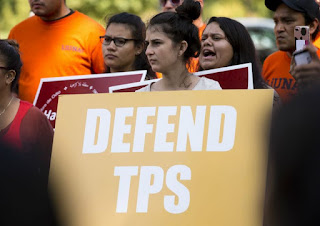
Temporary Protected Status
Trump Administration Tells 200,000 Salvadorans To Leave Or Get Deported
WASHINGTON ― The Trump administration will tell about 200,000 Salvadorans who have been living in the U.S. for 17 years or more that they need to get out by September 2019 or face deportation.
The Department of Homeland Security’s announcement on Monday that the administration will end temporary protected status, or TPS, for natives of El Salvador, comes after it did the same for about 50,000 Haitians and 2,500 Nicaraguans, and hinted it may soon eliminate protections for about 57,000 Hondurans. It also comes after President Donald Trump rescinded the Deferred Action for Childhood Arrivals program, or DACA, which granted deportation relief and work permits to nearly 700,000 current recipients.
That means nearly 1 million people currently allowed to live and work in the U.S. will soon be at risk of deportation unless they can find another way to gain legal status.
The Trump administration has indicated for months that it believes the “temporary” in “temporary protected status” has been wrongly overlooked for too long.
TPS for Salvadorans was first established in 2001 after earthquakes devastated the country. Only individuals who could show they had lived in the U.S. since before February 2001 can receive TPS, which allows them to work and live without fear of removal. Congressional Research Service puts the number of Salvadoran TPS recipients at about 260,000, but other experts say it is closer to 200,000 because some have gotten other immigration relief or left the country.
Monday, January 1, 2018
DACA Repeal
The Impact of DACA Program Repeal on Jobs
Earlier this year, FWD.us issued a report outlining the devastating consequences of a potential repeal of the DACA program, specifically outlining the dramatic and immediate job losses. Since that time, President Trump repealed DACA, urging Congress to pass a legislative fix by March 5th. Although some 22,000 individuals will already have lost DACA by that date, March 6th is when the number of DACA recipients losing work authorizations and protection from deportation will take a sharp and dramatic upturn.
The following report further details the escalating job losses that will occur beginning on March 6th and continuing for two years until all of the nearly 800,000 DACA recipients are prevented from participating in the workforce and subject to deportation. Specifically, this report looks at the job loss impact between March 6th and November 6th, the first 9 months when all DACA recipients will be barred from renewals. The findings reinforce the devastating consequences a repeal would inflict on DACA recipients and their families, as well as the dire, far-reaching consequences to communities across the country, to employers, and to the American economy across all regions and sectors.
This report specifically finds that a total of nearly 300,000 DACA recipients, 1,700 per business day, will be removed from the workforce between March 6th and November 6th.
In total, nearly 700,000 individuals who are currently employed and contributing as a productive part of the American workforce would be stripped of their ability to work and could be fired over the course of the next two years.,
Monday, December 18, 2017
What is TPS?
Temporary Protected Status (TPS)
What is TPS?
Temporary Protected Status, or TPS, is a life-saving immigration status that allows foreign nationals to remain in the U.S. if during the time they were in the U.S. something catastrophic happened in their country of origin preventing their safe return – for example war, famine, natural disaster, or epidemic. TPS allows people to work legally and be protected from deportation.
Who are TPS holders?
Will TPS be terminated for the designated countries?
The Trump administration has signaled it is in the process of phasing out the use of TPS. This means the administration will likely terminate TPS for many of the currently designated countries, affecting thousands of TPS holders, their families and communities.
Updates on Temporary Protected Status
Haiti: Haiti received an 18-month termination in Nov. 2017. The last day of TPS for Haiti will be July 22, 2019.
Sudan: TPS for Sudan received a 12-month termination in Oct. 2017. The last day of TPS for the Sudan will be Nov. 2, 2018.
South Sudan: TPS for South Sudan received an 18-month extension in September 2017.
Nicaragua: received a 12-month termination in Nov. 2017. The last day of TPS for Nicaragua will be Jan. 5, 2019.
Honduras: received a 6-month extension in Nov. 2017.
Upcoming TPS decision dates:
Jan. 8, 2018: El Salvador
Jan. 30, 2018: Syria
Apr. 25, 2018: Nepal
July 5, 2018: Yemen
July 19, 2018: Somalia
March 3, 2019: South Sudan
Monday, December 11, 2017
Immigrants and Their Children
Immigrants and Their Children Founded More Than Two-Fifths of All Fortune 500 Companies
The modern U.S. economy owes much of its success to the contributions of immigrants and their children. Among these contributions, it would be difficult to overstate the value of entrepreneurship. For instance, a new report from the Center for American Entrepreneurship (CAE) analyzes the role of immigrants and their children in 2017’s list of Fortune 500 companies.
Companies founded by immigrants include AT&T; Verizon; Procter & Gamble; PepsiCo; Pfizer; Goldman Sachs; and Facebook. Those founded by the children of immigrants include Apple; Ford Motor; Home Depot; Boeing; IBM; McDonald’s; and Staples. In total, 43 percent of all Fortune 500 companies were founded by an immigrant or the child of an immigrant.
These companies—which span numerous industries, from high-tech to retail to healthcare—wouldn’t exist if not for immigrants and their children.
CAE’s findings highlight just how critical immigrants are to the success of these powerhouse companies. Fortune 500 firms created by immigrants or the children of immigrants “are headquartered in 33 of the 50 states, employ 12.8 million people worldwide, and accounted for $5.3 trillion in global revenue in 2016,” according to the report.
Immigrants and their children are most prevalent among the biggest of the Fortune 500 companies, comprising 52 percent of the top 25 firms and 57 percent of the top 35. More precisely, 18.4 percent of today’s Fortune 500 companies were founded by at least one immigrant, and an additional 24.8 percent were founded by the child of an immigrant.
Monday, December 4, 2017
Neighbors Defend Immigrants
As Immigration Enforcement Ramps up, Neighbors Sign up to Defend Immigrants
In the face of heightened threats around immigration enforcement, communities are taking action to ensure due process for their undocumented community members. These rapid response efforts are being undertaken by a growing network of community members—from students to salesmen to social workers—who are volunteering to witness arrests conducted by Immigration and Customs Enforcement (ICE) agents.
Known as “Migra Watch” teams, these groups are forming around the country, and include groups like the Immigration Liberation Movement, a coalition of organizers, immigration attorneys, impacted individuals, and allies. This particular group was formed in the fall of 2016 and includes Migra Watch, which dispatches moral and legal observers to immigration raid sites.
Poised to act at a moment’s notice, Migra Watch volunteers are trained to manage distress calls, provide support to children whose family members have been detained or deported, and show up where ICE is conducting roundups of their immigrant neighbors. Trainings typically take place at churches or community centers, where legal residents and citizens are taught to not interfere with ICE operations, but to document them.
Volunteers are encouraged to take notes, photos, and provide eyewitness testimony if they believe ICE has acted outside of its authority. Most importantly, they use this information to track where the arrested immigrant is being sent and direct legal help to that location in the hopes of delaying or stopping the deportations of their friends and neighbors.
Subscribe to:
Posts (Atom)