Monday, March 19, 2018

Americas Schools on ICE

LEGiTiGO


How Aggressive Immigration Enforcement Hurts America’s Schools

Immigration enforcement has become increasingly severe, especially in the past year. Yet news coverage often merely scratches the surface of what people across the country are experiencing. Consequently, one topic that often gets left out of the larger conversation is the deep and lasting impact immigration enforcement has on the education of children.

Increasingly, education and childcare professionals report that this harsh approach to immigration enforcement is harming the environment in schools and childcare centers and, more broadly, the communities of students and families they serve. Two recent multi-state surveys add to a growing body of evidence demonstrating how immigration enforcement negatively affects children in the United States.

The first, a national survey of pre-K through high school educators conducted by the Civil Rights Project at UCLA, reveals that immigration enforcement has negatively impacted U.S. schools and classrooms. Of the 5,438 teachers, administrators, and other school staff surveyed between October 2017 and January 2018, 73 percent observed potential impacts of immigration enforcement at their school.

“Fear” and “separation” were the two most common words used when describing students’ immigration concerns, based on about 3,500 responses from personnel in 730 schools in 12 states. Thousands of educators described how their students from immigrant families, the vast majority of whom are U.S.-born, “were terrified that families and friends, and occasionally they themselves, would be picked up by ICE… and that it was, at times, very difficult for students to learn and teachers to teach.”

Monday, March 12, 2018

Abolish ICE?


It’s Time to Abolish ICE
A mass-deportation strike force is incompatible with democracy and human rights.

Dan Canon is running for Congress in Indiana’s ninth district this year. A career civil-rights lawyer, Canon filed one of the cases against gay-marriage bans that eventually became the landmark Obergefell v. Hodges, and he proudly wore a Notorious RBG shirt under his suit to the Supreme Court. He is currently representing individuals suing Donald Trump for inciting violence at his rallies.

Canon has also defended clients swept up by Immigration and Customs Enforcement raids, and fought a Kafkaesque deportation system that, at one point, wouldn’t even disclose the location of his client. Now Canon believes ICE should be abolished entirely.

“I don’t think a lot of people have any kind of direct experience with ICE, so they don’t really know what they do or what they’re about. If they did, they’d be appalled,” Canon told me. “ICE as it presently exists is an agency devoted almost solely to cruelly and wantonly breaking up families. The agency talks about, and treats, human beings like they’re animals. They scoop up people in their apartments or their workplaces and take them miles away from their spouses and children.”

The idea of defunding ICE has gained traction among immigrant-rights groups horrified by the speed at which, under President Donald Trump, the agency has ramped up an already brutal deportation process. Mary Small, policy director at Detention Watch Network, said, “Responsible policymakers need to be honest about the fact that the core of the agency is broken.” Her group led the charge to defund ICE with its #DefundHate campaign last year.

Monday, March 5, 2018

USCIS Mission Statement


Removal of ‘Nation of Immigrants’ from USCIS Mission Ignores Agency’s Mandate and American History

Francis Cissna, Director of the United States Citizenship and Immigration Services (USCIS), unveiled a new mission statement for the agency last week, notably deleting the words “a nation of immigrants” as well as other key principles central to the agency’s work.

Given the sweeping changes underway in the enforcement and adjudication of immigration laws, changing a few words here and there in a mission statement—something that is not mandated by law—may seem trivial. But for USCIS, the prior mission statement was a touchstone of the why and the how, informing both employees and the public of the core values driving the work of the agency. Removing references to a nation of immigrants, the promotion of citizenship, and customer service cuts the heart out of the agency.

The previous mission statement, unveiled as part of its first strategic plan in 2005 under the Bush administration by then USCIS Director Eduardo Aguirre, read:

“USCIS secures America’s promise as a nation of immigrants by providing accurate and useful information to our customers, granting immigration and citizenship benefits, promoting an awareness and understanding of citizenship, and ensuring the integrity of our immigration system.”

The new mission statement reads:

“USCIS administers the nation’s lawful immigration system, safeguarding its integrity and promise by efficiently and fairly adjudicating requests for immigration benefits while protecting Americans, securing the homeland, and honoring our values.”

The new version lacks context, as it no longer grounds the agency’s work in the history of our country. There is no vision connecting the past to the present or to the future. There is no mention of the important role USCIS plays in promoting and celebrating citizenship.

There is also a deliberate elimination of the reference to serving “customers,” purportedly to avoid treating immigration adjudications as a mere commodity. Yet USCIS was created in part because of the feeling that applicants were ill-served by the Immigration and Naturalization Service, with abysmal backlogs and a lack of information and transparency. Moreover, it is hard not to think of the petitioners and applicants as customers, since the agency is almost entirely funded by fees paid by these people, who simply want efficient and fair treatment—like most customers everywhere.


Monday, February 26, 2018

TPS Lawsuit

LEGiTiGO


Lawsuit to Stop Blocking TPS Holders from Applying for Green Cards

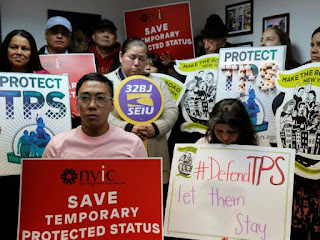
Temporary Protected Status (TPS) is an important humanitarian protection for people who are in the United States when certain natural disasters or civil conflict strike their home countries, making it unsafe for them to return. Despite the fact that conditions in many of these countries have not improved since their nationals received TPS, the U.S. administration recently announced that it is ending protection for several countries. If the people who lose TPS are deported, this could ultimately force hundreds of thousands of people to return to destabilized countries.

A new lawsuit, however, could help some TPS holders who have especially strong connections to the United States qualify for permanent legal status in this country. Given the administration’s decision to terminate these protections, it is especially important that TPS holders have a fair opportunity to apply for another type of legal immigration status if they are eligible.

The lawsuit asks the court to stop immigration officials from denying TPS holders’ applications based on a faulty interpretation of the law and was filed as a class action in New York. The plaintiffs are TPS holders who have applied to be lawful permanent residents based on close family relationships or their employment.

When an immigrant applies to become a lawful permanent resident of the United States, he or she must meet a wide and rigorous set of eligibility criteria. One requirement is that the immigrant show that he or she has been “admitted and inspected” into the United States—essentially, that immigration officials reviewed and agreed to an immigrant’s request to be in the United States.


Monday, February 19, 2018

Olympics Immigrant

LEGiTiGO


Immigrants Bring Home the Gold for the U.S. Olympics Team

From their meme-worthy Opening Ceremony gloves to some stunning wins on the halfpipe, Team USA has started the 2018 Winter Olympics off with a bang. Early victories in the Pyeongchang, South Korea games would not be possible without this entire group of 242 talented

Americans—including the multiple athletes that have benefited from the United States’ immigration system and have gone on to compete for our country.

It’s not just the United States, either – countries all over the world benefit from having welcoming immigration policies.

Roughly 6 percent—or 178 Olympians—of all athletes in in this year’s games are competing for a country they weren’t born in. In fact, 12 countries are represented by athletes that are exclusively foreign-born, including Nigeria, Tonga, Bermuda, and Thailand.

One of these athletes is Maame Biney, who immigrated to the United States from Ghana at age five. She is the first black woman on the U.S. Olympic speedskating team and has stunned viewers with her agility on the ice.

Biney initially tried out ice skating after moving to the United States but was instructed by a coach to do speedskating instead – even as a child, she was too fast for ice skating. Judging by her successes with Team USA, speedskating obviously won out.

Monday, February 12, 2018

Olympian

LEGiTiGO


Proud Immigrant Parents of American Olympian Hopeful.

Making it to the Olympics takes passion, hard work, and talent, but it also helps to have a supportive family in your corner too. There's no denying that 18-year-old figure skater Nathan Chen's parents are supporting him every step of the way. Since the Olympian first strapped on a pair of skates at age 3, his parents, Zhidong Chen and Hetty Wang have been encouraging their son to never give up, and their persistence has paid off in a big way for Chen.


At the 2017 U.S. Figure Skating Championships, Chen made history when he became the first skater to ever land five quadruple jumps in one routine. His achievement would be impressive all on its own, but when you factor in the fact that in 2016, Chen suffered a hip injury that left him benched for six months, his performance becomes all the more remarkable. Much like his parents, Chen is proving that his drive to succeed is unwavering.


Chen is a first generation American whose parents immigrated from China in 1988. His father, Zhidong, is a medical research scientist who worked and went to school at the same time, and his mother, Wang, is a medical translator. In an interview with NBC, Chen credits his parents strong example for helping him stay focused at such a young age. When asked what the best piece of advice he had ever received was, Chen said,

"My parents always enforce the idea of never giving up upon all of my siblings and me, and I think that's something that will stick with me my whole life."

Monday, February 5, 2018

Immigrant Professionals

LEGiTiGO


IMMIGRANT PROFESSIONALS DETAINED BY ICE

ICE Detains Chemistry Professor Before He Can Say Goodbye To His Family

Immigration and Customs Enforcement (ICE) detained a Kansas chemistry professor as he was leaving his front yard to take his seventh-grade daughter to school last week.

Immigration authorities took 54-year-old Syed Ahmed Jamal on Jan. 24 before his family was able to say goodbye to their husband and father who arrived in the U.S. 30 years ago from Bangladesh.
As immigration authorities handcuffed Jamal, his daughter rushed into the house to tell her mother and brother. His wife tried to hug her husband as agents took him away and was told she could be charged with interfering, according to The Kansas City Star.

ICE detains a Polish doctor and green-card holder who has lived in the U.S. for nearly 40 years

Lukasz Niec was 5 years old when his parents brought him and his sister to the United States from Poland. With two suitcases in tow, his parents — both doctors — left behind a country on the verge of social turmoil. It was 1979, about two years before the country’s authoritarian communist government declared martial law.

Niec received a temporary green card and, in 1989, became a lawful permanent resident. He grew up in Michigan, went to medical school, became a doctor, and raised a daughter and stepdaughter.

Niec, now 43, never fathomed that his legal status in the United States would become an issue. With a renewed green card, and nearly 40 years in the country, his Polish nationality was an afterthought for Niec, his sister told The Washington Post. He doesn’t even speak Polish.

But on Tuesday morning, immigration authorities arrested Niec at his home, just after he had sent his 12-year-old stepdaughter off to school. Niec, a physician specializing in internal medicine at Bronson Healthcare Group in Kalamazoo, Mich., has been detained in a county jail ever since, awaiting a bond hearing and possible deportation.